70V / 60A Sensorless FOC Controller for Robotic & Servo Motor Control
The VDriveMotion Phasor50™ combines pulsating high-frequency signal injection (HFI) with ultra-low noise Dynamic Over-Sampling to deliver 100% hold torque at zero speed. Experience whisper-silent, high-bandwidth servo motor control for BLDC and PMSM actuators—eliminating fragile encoders and broken sensor wiring entirely.
Instant in-browser motor tuning via WebSerial at tool.vdrivemotion.com →

Built for What Actually Matters in the Field
Three fundamental breakthroughs engineered to eliminate fragile sensor wiring, painful setup toolchains, and acoustic motor noise in high-performance robotics.
Full Stall Torque at 0 RPM
In compact robotic actuators, thin 5-to-8 wire encoder harnesses repeatedly flex, fatigue, and break under vibration and harsh mechanical joint movement. Phasor50 eliminates external encoders entirely using High-Frequency Injection (HFI) to track magnetic rotor saliency—delivering 100% rated stall torque and servo position hold from a dead stop without a single sensor wire.
- 100% holding torque from 0 RPM (true dead stop)
- Zero external encoder discs or fragile cabling
- Immune to joint vibration, dust, and flex fatigue
Tune in Minutes. Zero Installs.
Stop losing days battling broken Python virtual environments, driver signing issues, and complex command-line toolchains just to spin a motor for the first time. Plug in via USB-C and open Chrome or Edge. Our autonomous self-commissioning engine characterizes your motor in under 60 seconds, automatically dialing in optimal control loops so you can spin immediately.
- Native WebSerial API — nothing to install or compile
- <60s self-commissioning characterizes the motor automatically
- Real-time browser telemetry, oscilloscope, and live tuning
Whisper-Silent Actuation
Standard motor controllers suffer from noisy ADC sampling that produces irritating high-frequency coil whine and micro-vibrations—unacceptable in collaborative robotics, medical devices, and camera gimbals. Phasor50 uses Dynamic Over-Sampling (DOS) to achieve high-resolution 14-bit current sensing, eliminating measurement ripple and delivering pure sinusoidal phase power with dead-silent motion.
- Zero high-frequency coil whine in sensitive environments
- Pure sinusoidal phase currents via 14-bit oversampled current sensing
- Vibration-free position hold for direct-drive precision
70V / 60A High Power Density
170 MHz ARM Cortex-M4 motion core delivering up to 60.0A RMS continuous phase current (80A peak limit) across 12V–70V DC buses.
Deterministic Robot Host Control
Zero-latency serial communications over USB CDC Virtual COM port and CAN FD with binary COBS framing for Linux SBCs and ROS 2.
Zero-Install Safe Firmware Updates
Flash official updates in-browser with authenticated .vdfw containers, hardware ID checks, and anti-brick protection.
Zero-Speed Sensorless FOC vs. Conventional Drives
Standard sensorless drives go blind at zero RPM when Back-EMF collapses to zero, causing startup jitter and zero hold torque. Phasor50™ solves this physical constraint with High-Frequency Injection (HFI), delivering full servo-grade holding torque from a dead stop without encoder harnesses.
Back-EMF Observers Only
Standard ESCs and basic sensorless inverters that depend solely on motor rotation to generate measurable Back-EMF.
Back-EMF is strictly proportional to velocity (e = Ke · ω). At zero speed, signal amplitude is 0V, leaving the rotor unobservable and freely spinning under load.
Requires blind forced-commutation pulses. Prone to reverse jerk, torque dips, and stall tripping when starting against high-inertia robotic joints.
Forces designers to add optical or magnetic encoders, introducing 5 to 10 vulnerable harness leads prone to EMI, vibration fatigue, and connector disconnects.
Unfiltered ADC shunt sampling injects measurement noise into the current PID loop, producing high-frequency audible hiss in motor stator coils.
HFI Saliency + Disturbance Flux Observer Tracker
Advanced field-oriented control combining high-frequency carrier injection with disturbance flux observer tracking and dynamic sensor fusion.
Pulsating D-axis carrier voltage detects magnetic saliency (Lq ≠ Ld), acquiring absolute rotor angle at 0 RPM to hold full rated stall torque indefinitely.
Instantaneous angle tracking provides smooth, closed-loop breakaway from a dead stop under 100% load with zero reverse cogging and zero missed steps.
HFI tracks magnetic saliency at low speed while the disturbance flux observer tracker estimates rotor angle at high speed—eliminating encoder discs, harnesses, and alignment points.
Dynamic Over-Sampling (DOS) in CCMRAM dramatically lowers current sensing error, preventing noise amplification in the PID loop for silent actuation.
Deterministic Host Interfacing & Robot Control
Direct USB CDC Virtual COM port communications powered by a high-throughput binary wire protocol. Designed for jitter-free real-time telemetry streaming in ROS 2, Linux SBCs, and custom embedded platforms.
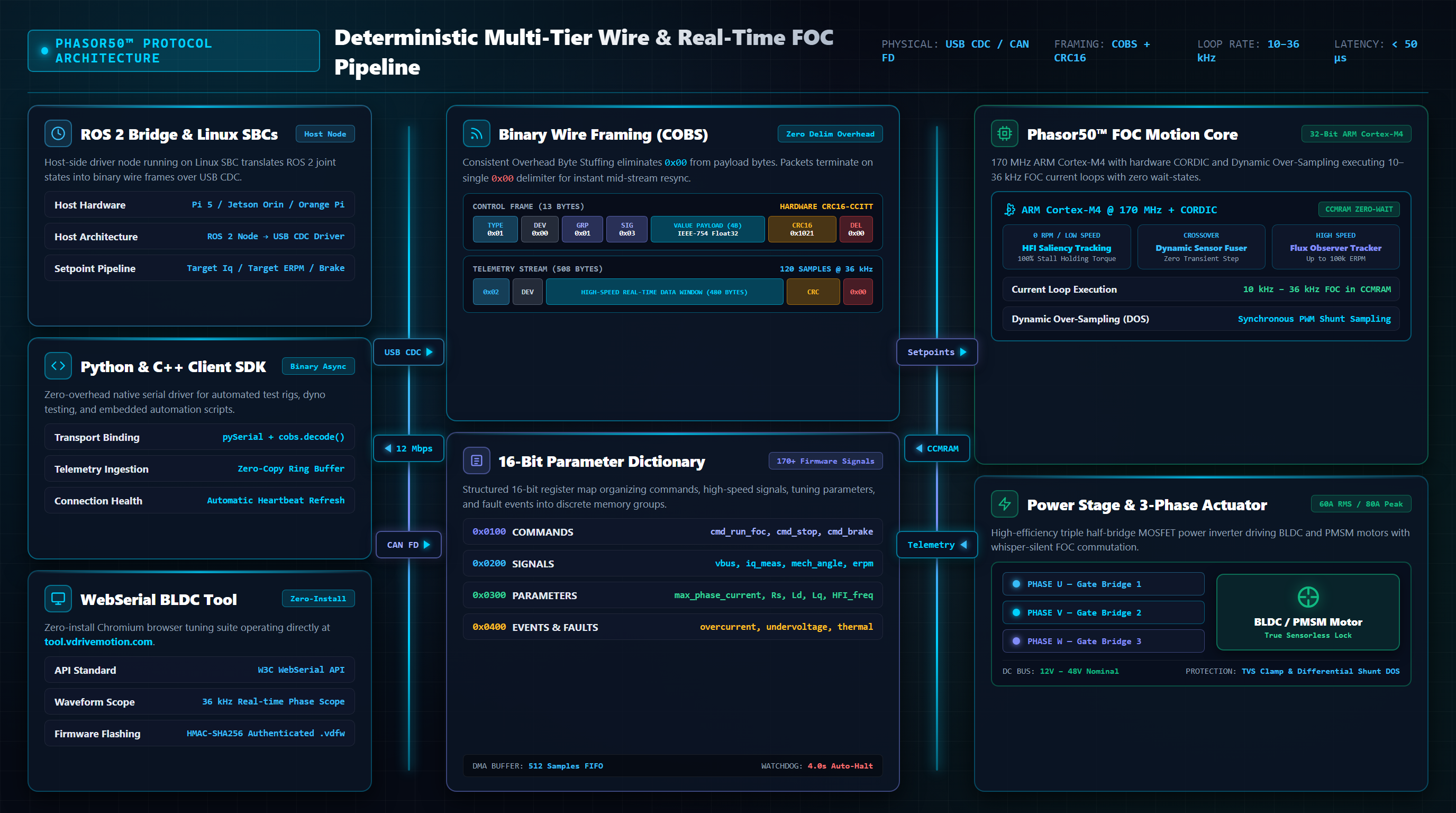
Binary Wire Protocol
Zero-overhead packet framing with hardware CRC16 and CRC8 validation. Eliminates ASCII/CSV string parsing overhead for microsecond-deterministic latency.
Parameter Dictionary
Structured address space organizing 170+ firmware parameters and signals: commands (0x0100), telemetry (0x0200), motor limits (0x0300), and fault events (0x0400).
Real-Time Control Loop
Stream 3-phase currents, DC bus voltage, velocity, and mechanical rotor angle directly into ROS 2 motor nodes, Linux SBCs, or Python robot control scripts.
Browser-Based BLDC & PMSM Commissioning
Direct hardware configuration, autonomous calibration, and real-time telemetry straight from Chromium browsers via the WebSerial API. Connect your controller over USB-C to inspect cycle-by-cycle waveforms and flash parameters instantly.

WebSerial Plug-and-Play
Direct USB-C communication in Chrome or Edge. Access complete register configurations with zero compiler toolchains or driver installs.
<60s Autonomous Wizard
Autonomous 2-point stator resistance test (canceling MOSFET Voffset), inductance characterization, and dead-time compensation.
36 kHz FOC Telemetry
Multi-channel 60 FPS plotting of phase currents (Iu, Iv, Iw), bus voltage, and 360° mechanical angle directly from the FOC core.
Non-Volatile Flash Memory
Tune current loop PI gains and observer parameters interactively, then write verified parameters directly to onboard non-volatile Flash.
Verified Engineering Specifications
Rigorous ratings sourced directly from the Phasor50™ architecture, calibrated physical circuit components, and zero-wait-state CCMRAM firmware limits.
Electrical & Power Ratings
| Operating Bus Voltage (Vbus) | 12V – 70V DC Operating range (10V UVLO cutoff) |
| ADC Voltage Ceiling | 77.5V Full Scale 82k + 3.3k divider (ratio 25.85) |
| Continuous Phase Current | 60.0A RMS ±60A sensing via 1 mΩ shunts |
| Peak Phase Current | 80.0A Peak Hardware & firmware safety limit |
| Gate Driver Supply Voltage | 8V / 10V / 12V / 15V Integrated buck regulator (default 10V) |
| Quiescent Standby Power | ~15 μA Low-dropout quiescent standby mode |
Processing & FOC Engine
| Processing Architecture | 32-Bit ARM Cortex-M4 170 MHz core with FPU & CORDIC coprocessor |
| Hardware Math Accelerator | CORDIC Coprocessor Cycle-level trigonometric calculations |
| Execution Memory | CCMRAM (Zero-Wait) Core-coupled RAM + 112 KB Flash |
| PWM Switching Frequency | 24.0 – 36.0 kHz Center-aligned Space Vector Modulation |
| FOC Current Loop Execution | 24.0 – 36.0 kHz Cycle-by-cycle ADC execution in CCMRAM |
| Current Sensing Technique | Dynamic Over-Sampling CCMRAM Duff's Device dual-channel packing |
Motion & Sensorless Control
| Zero-Speed Holding Torque | 100% Stall Torque Pulsating D-axis HFI (Lq ≠ Ld saliency) |
| High-Speed Tracking | Disturbance Flux Observer Zero-latency flux & disturbance tracker |
| Maximum Electrical Speed | 100,000 ERPM Dynamic range ceiling (0x0330) |
| Dynamic Fuser Crossfade | ~1,500 ERPM Window Glitch-free HFI-to-observer blend |
| Mechanical Position Tracking | 360° Continuous Electrical-to-mechanical conversion |
| Required External Sensors | None (0 Wires) True sensorless (no encoders or Halls) |
Telemetry, Protocol & Physical
| Host Interface | USB CDC Full-Speed Direct native USB-C connection |
| Wire Communication Protocol | Binary COBS Framing CRC16/CRC8, zero ASCII/CSV latency |
| Configuration & Tuning | WebSerial Browser App tool.vdrivemotion.com (Chrome & Edge) |
| Self-Commissioning Engine | < 60s Autonomous 2-point Rs & Ls measurement + dead-time |
| Acoustic Audio Playback | 36 kHz Float32 Stream Stator coil acoustic output (0x0373) |
| Deceleration & Braking | Phase Current Regulation Bus capacitance (no external resistor) |
Integrated Power Dissipation Architecture
The Phasor50™ is engineered as a highly compact, self-contained inverter. It does not require or feature an external braking / regen resistor; kinetic deceleration energy is managed directly through closed-loop motor phase current regulation and low-ESR bus capacitance.
Frequently Asked Questions
Deep-dive technical answers for embedded systems, robotics, and drive engineers evaluating the Phasor50™ platform.
How does the Phasor50 deliver full stall torque and position hold at 0 RPM without an encoder?
Conventional sensorless drives rely on Back-EMF, which drops to 0V at standstill—creating a blind zone where rotor position cannot be observed. The Phasor50 overcomes this by injecting a pulsating high-frequency carrier signal into the motor direct (d) axis. Because brushless rotors exhibit magnetic saliency (quadrature inductance differs from direct inductance, Lq ≠ Ld), this carrier generates a distinct high-frequency current ripple. The onboard hardware CORDIC coprocessor tracks this angle in real time at up to 36 kHz, delivering 100% rated stall torque and position hold at true 0.0 RPM without physical optical encoders or Hall effect sensors.
How do I interface the controller with ROS 2, Linux, or custom microcontrollers?
The Phasor50 features a native USB-C port operating as a high-throughput USB CDC Full-Speed Virtual COM Port. Host communications use a zero-overhead binary wire protocol encoded with Consistent Overhead Byte Stuffing (COBS) and validated via hardware CRC16 and CRC8 checksums. All controller states, setpoints, and live signals map to a structured 16-bit parameter dictionary. Host systems stream 3-phase currents, DC bus voltage, velocity, and rotor angle at deterministic loop rates using Python bindings, C/C++ header definitions, or standard ROS 2 motor control nodes with zero ASCII/CSV parsing overhead.
Why is current control whisper-silent compared to standard BLDC motor controllers?
In typical motor drives, switching ripple and ADC quantization errors inject measurement noise directly into current feedback signals. The PID controller attempts to react to this noise, producing audible coil whine and parasitic vibration. VDriveMotion eliminates this with Dynamic Over-Sampling (DOS) executed in zero-wait Core Coupled Memory (CCMRAM). Dual high-speed ADCs sample the current shunt array in parallel using an unrolled branchless Duff's Device routine, averaging up to 17 samples per switching cycle. This slashes measurement ripple, resulting in pure sinusoidal current waveforms and silent operation.
Which motor topologies and supply voltage ranges are supported?
The Phasor50 is engineered for 3-phase brushless DC (BLDC) and permanent magnet synchronous motors (PMSM) operating across an operating bus voltage range of 12V to 70V DC (compatible with 4S to 16S LiPo battery systems). It delivers up to 60.0A RMS continuous phase current with an 80A peak current limit. Standby power consumption is approximately 15 µA. Kinetic deceleration energy is managed directly through closed-loop motor phase current regulation and low-ESR bus capacitance, eliminating the need for bulky external braking resistors.
Do I need to install desktop software, drivers, or compilers to calibrate my motor?
No. Motor commissioning and PID tuning require zero software installations, zero compiler toolchains, and no manual USB driver configurations. By opening tool.vdrivemotion.com in any modern Chromium browser (Chrome, Edge, Opera), the WebSerial API connects directly to the controller over USB. The integrated calibration engine runs an autonomous 2-point stator resistance test (Rs at 1A and 3A cancelling MOSFET Voffset), identifies stator inductances (Ld, Lq), characterizes dead-time compensation look-up tables, and configures current loop gains in under 60 seconds.
Reserve Early Developer Batch Access
We are finalizing evaluation units of the Phasor50™ for robotics teams, drone builders, and motion control engineers. Join the waitlist for priority batch allocation, direct firmware changelogs, and binary wire protocol releases.
Zero spam. Unsubscribe at any time with a single click.